Frontier physics target set v1
Purpose
This is the corpus's consolidated frontier-physics lane. It turns the distributed admissibility work into a finite target set without pretending that every mapped item has the same evidential status. The machine-readable authority is the target register; this document is its working view.
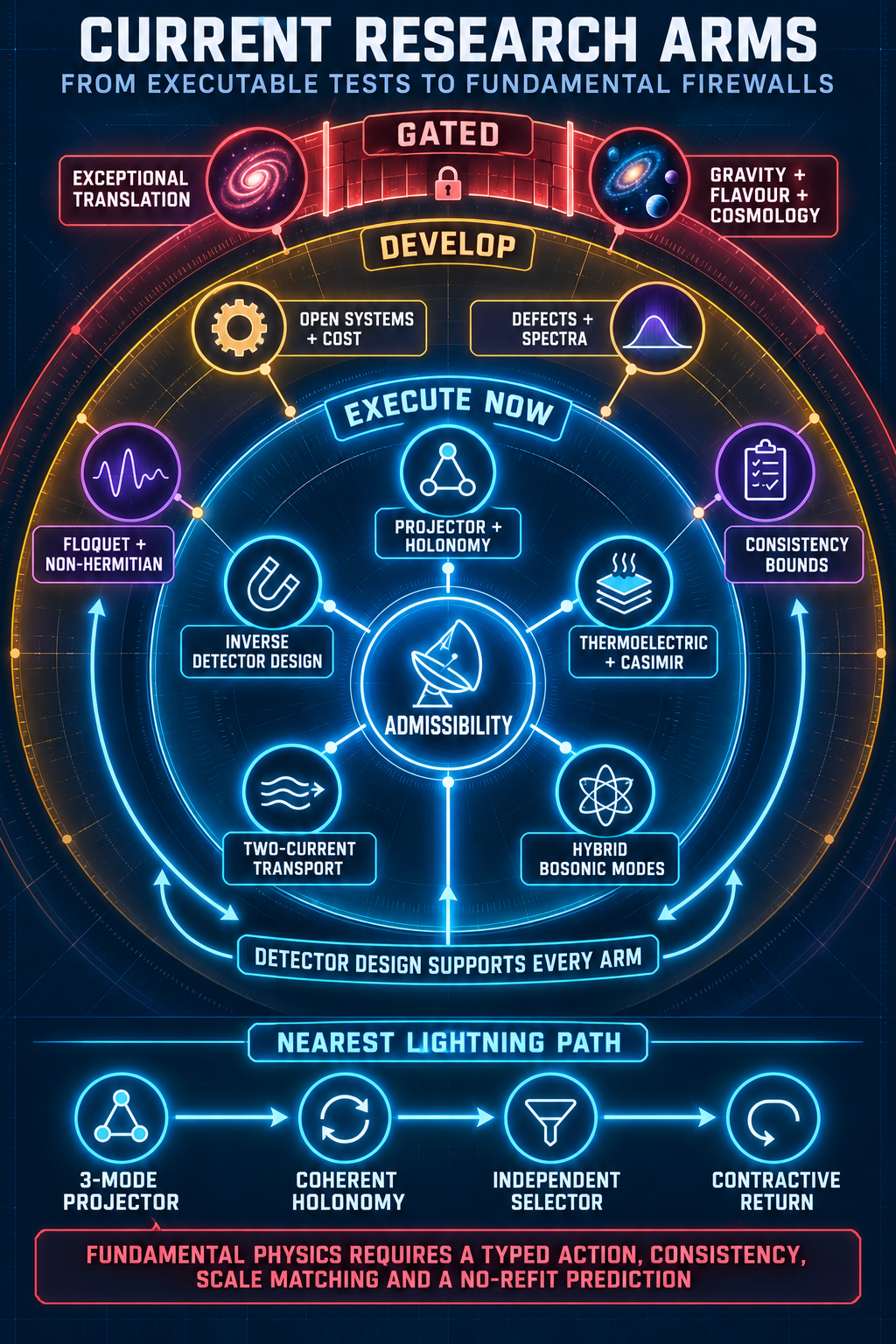
The target set is deliberately organized around objects that could be calculated, built, measured or ruled out. It is not a catalogue of interesting words. A target remains useful when its strongest interpretation fails: the usefulNull field in the register records the conventional scientific residue.
The target set is now complemented by the detector and frontier atlas and maintained open-topic queue. Those artifacts make explicit which records can move each boundary and which questions remain live, gated or blocked.
Core map
| ID | Frontier target | Workflow | Present boundary |
|---|---|---|---|
| FPT-001 | Open-system contractive selection | execute now | Realize holonomy, monitoring, trajectories and a resource ledger in one physical platform without inserting the desired answer into the update law. |
| FPT-002 | Inverse detector design and equivalence classes | execute now | Find the least-cost channel that separates the worst mechanism pair after detector folding and nuisance projection. |
| FPT-003 | Same-carrier thermoelectric--Casimir closure | execute now | Close one causal material tensor across Hall, Seebeck, Nernst and boundary force/torque while beating ordinary backgrounds. |
| FPT-004 | Two-current Planckian transport | execute now | Implement the continuity-derived periodic energy current before interpreting the particle/energy spectral rank. |
| FPT-005 | Phonon, magnon and hybrid-mode laboratories | execute now | Resolve transported mode geometry, or adversarially separate it from damping and scattering. |
| FPT-006 | Non-Hermitian and Floquet geometry | develop | Reconstruct coherent holonomy independently of gain/loss-conditioned dynamics. |
| FPT-007 | Defects, walls and index-protected transport | develop | Identify what physical information, beyond protected mode count, a defect transports. |
| FPT-008 | Hydrodynamic stress and constitutive cones | develop | Determine whether conservation leaves a multichannel response cone or a low-rank ray. |
| FPT-009 | Quantum codes and synthetic gauge laboratories | develop | Derive allowed logical generators from a physical carrier rather than universal programmability. |
| FPT-010 | Scattering, causality and positivity bounds | develop | Derive one admissibility inequality not reducible to standard unitarity, analyticity, causality or positivity. |
| FPT-011 | Flavour, neutrino and CP geometry | hold | Derive a gauge-compatible path and overlap operator that predicts rather than imports Yukawa structure. |
| FPT-012 | Gravity, torsion and rotating-source probes | hold | Conventional coefficient selection is exhausted; reopening requires one of two explicit new-physics gates. |
| FPT-013 | Cosmology, relic defects and joined likelihoods | hold | Supply one covariant model with common parameters across expansion, perturbations, lensing and structure. |
| FPT-014 | Constructive continuum and mass-gap control | hold | Replace finite scans with a regulator-, volume-, time- and operator-uniform estimate. |
| FPT-015 | Thermodynamic cost of selection | develop now | Compare equilibrium, driven and measurement-conditioned selectors at matched apparent contraction. |
| FPT-016 | Measurement backaction and records | develop now | Separate trajectory-conditioned selection, the unconditional channel and stored records. |
| FPT-017 | Scale dependence and renormalization | develop | Construct a three-scale carrier and test which invariants survive coarse-graining without fitted basis maps. |
| FPT-018 | Rare events, metastability and hysteresis | required diagnostic | Use rate functions, escape paths, waiting time and sweep rate to distinguish symmetry breaking from kinetic freezing. |
| FPT-019 | Complexity and computational accessibility | audit column | Separate existence, preparation, sampling, detection and verification costs. |
| FPT-020 | Causal spread and scrambling | required diagnostic | Compare selector mixing with calibrated propagation and resource bounds. |
| FPT-021 | Disorder, glassy memory and robustness | audit column | Scale disorder, sample count and waiting time together on the same carrier. |
| FPT-022 | Triality quotient scars and hidden-mode recovery | execute now | Realize a hub plus three cyclic outer modes with individual, summed and oriented contrast records. |
Current execution queue
- Platform selector: FPT-001 + FPT-015 + FPT-016. Put holonomy, monitoring, trajectory records and thermodynamic cost in one experiment.
- Detector-equivalence simulator: FPT-002. Build the global forward model before optimizing a local sensitivity.
- Physical energy current: FPT-004. Finish the production periodic operator and its convention tests.
- Co2MnGa closure: FPT-003. Propagate one measured tensor into the differential Casimir observable.
- Quotient-scar platform: FPT-005 + FPT-006 + FPT-022. Build the four-mode star and test dark-mode deletion, nonlinear memory and oriented recovery.
This queue is a workflow ranking, not an epistemic ranking. execute_now means that a sharp next calculation or experiment exists; it does not mean that the ambitious interpretation is likely to be true.
Admission and failure rules
- Standard or exact-local results may establish mathematics, calibration or a platform-local physical statement.
- Empirical neighbours establish that a conventional laboratory realizes part of the required structure, not that the corpus interpretation follows.
- Candidate bridges require both endpoint definitions, a typed translation and a discriminator against the nearest conventional account.
- Open targets are questions, not claims.
- Blocked or no-go targets remain visible so effort is not silently recycled into an exhausted route.
- Speculative zero-weight arcs may suggest experiments or translations but contribute no evidence until they independently pass the ordinary gates.
“New physics” is not the reward for an anomaly. It becomes a live interpretation only after the observable, conventional envelope, nuisance model, independent replication and competing extensions have all been specified. For the exhausted torsion--flavour coefficient route, the register is stricter: only a new UV grading/nonrenormalization theorem or a computed interacting matter--gravity fixed point with a matched low-energy trajectory reopens the claim.
How to use the lane
Start with an FPT identifier, follow its sourceRefs into the corpus, and use the coverage map to see which older branches, external phenomena, speculative arcs and execution packets touch it. Add new programme-level targets to the JSON first, preserving their gate, kill test and useful null; then update the readable maps and run the verifier.