Muqarnas: Discrete Cells Approaching a Dome
Muqarnas are constructed from finite, modular cells arranged in tiers. Each cell is piecewise planar. As subdivision increases, angular discontinuities reduce and spatial frequency rises. Before the apex, the structure appears smooth.
This is a piecewise-linear approximation of a curved surface — a discrete geometric system converging to a smooth manifold as resolution increases.
a smooth manifold as resolution increases.
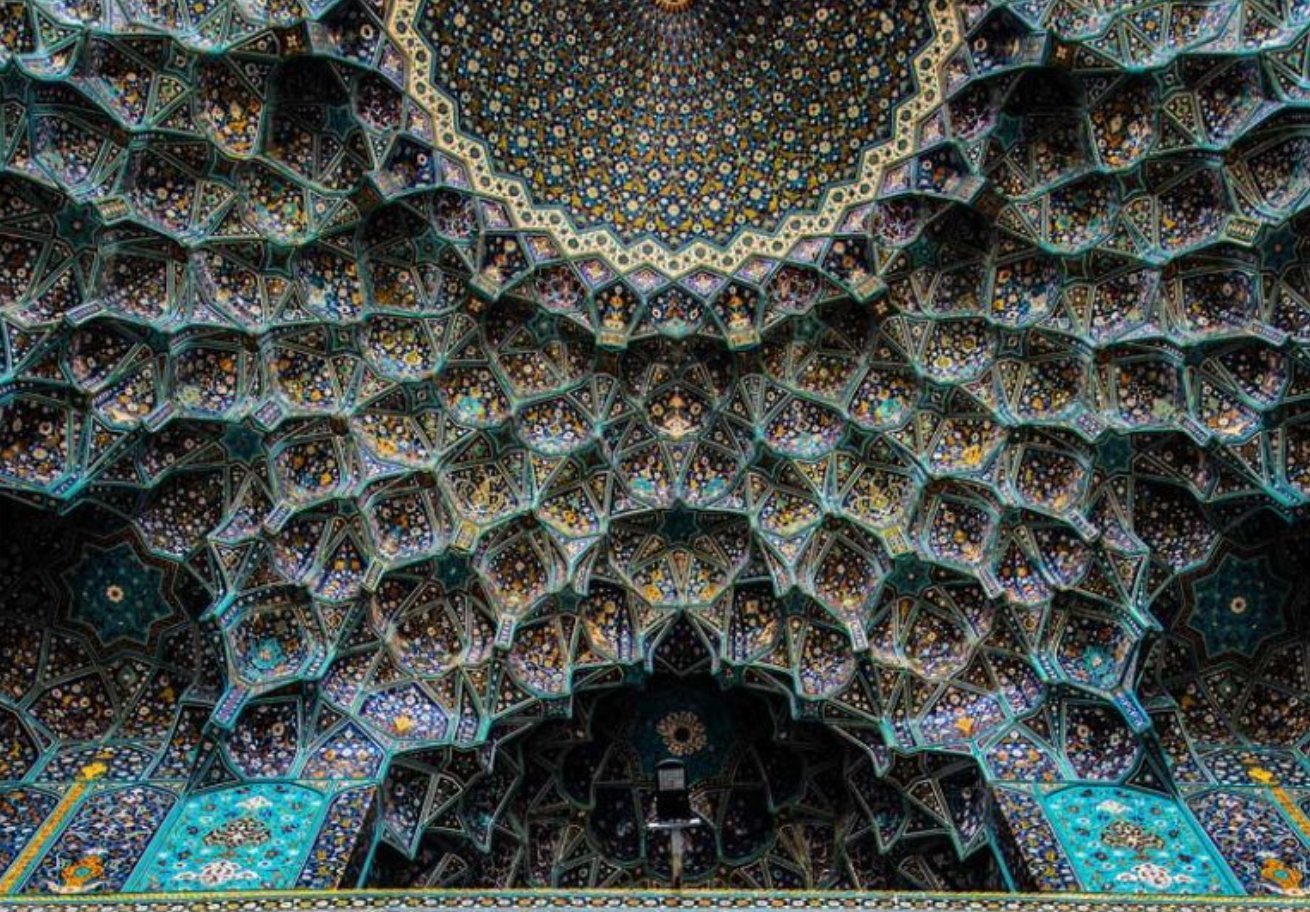
Perception vs. Geometry
The apparently “chaotic” region near an apex is highly structured and dense in orientation. The transition to smoothness occurs when feature size drops below perceptual resolution.
Pixels become image. Mesh becomes surface. Continuity is often perceived, not intrinsic to the underlying structure.
Symmetry Refinement: D₄ → SO(2)
A square has D₄ symmetry — dihedral group of order 8. Refinement produces D₈ → D₁₆ → … The angular spacing shrinks: 2π/n → 0.
Discrete rotational symmetries become dense and approximate continuous rotation. The circle group SO(2) emerges as the limit of discrete refinement.
of discrete symmetry refinement.
From Position to Orientation
Lower regions operate in Cartesian coordinates (x, y) with grid-based logic. Upper regions shift to radial and angular structure where orientation dominates over position.
Geometry transitions from position space to an orientation (phase) field. This is the shift from where to which-way.
to an orientation field.
Removing Scale: The Quaternion Insight
The non-zero quaternions decompose cleanly:
// magnitude × pure rotation
Normalizing: q → q/|q| discards the magnitude and retains pure rotation. The quaternion lives in SU(2) — the 3-sphere. Structure simplifies by factoring out scale, leaving only symmetry.
leaving symmetry.
Octonions: Local vs. Global Structure
The division algebra tower:
The octonions are non-commutative and non-associative — but they are alternative:
Any two octonion elements generate an associative subalgebra. Local (2-element) systems behave associatively. Global structure is twisted.
global coherence breaks.
Multiplication as Discrete Structure
Octonion multiplication is encoded by the Fano plane — a combinatorial structure of 7 points and 7 lines. Each of the 7 oriented triples defines a quaternionic subalgebra. Triples are associative. The full structure is not.
A combinatorial structure (the triples) completely defines continuous algebraic behavior. Discrete rules encode the algebra.
continuous algebraic behavior.
Emergence of G₂
G₂ is the symmetry group of octonion multiplication. It acts on ℝ⁷ (the 7 imaginary octonions) and has dimension 14. It preserves multiplication, alternativity, and the Fano plane structure.
Only transformations that preserve all local rules are permitted. G₂ is the set of these transformations — the continuous group that guards the discrete structure.
of the octonion algebra.
Algebra ↔ Geometry
SO(7) contains all rotations in ℝ⁷. G₂ is the subgroup that also preserves octonion structure. The bridge between algebra and geometry is a special 3-form φ that encodes multiplication geometrically:
The 3-form φ translates discrete multiplication rules into geometric language. G₂ is where algebra and geometry become one object.
to continuous rotations in ℝ⁷.